
Blog

How to Choose the Right Heat Sealing Cover Tape?

Choosing the right Heat Sealing Cover Tape is not a simple matter of selecting the strongest adhesive. The tape must match the tray material, sealing temperature, equipment pressure, and product sensitivity. A cover that seals firmly may still peel poorly, leave residue, or damage delicate components during opening.

Packaging specialist Dr. Gordon L. Robertson has stated, “A package must protect its contents from the environment, and the contents must not adversely affect the package.” This principle fits cover tape selection closely. A tape used with PET trays may behave differently on PS, PVC, or paper-based materials. The same roll can also perform differently when the sealing jaw is too hot, too cold, or unevenly pressed.

Start with the application.

Consider the substrate, seal window, peel force, barrier needs, and storage conditions. For electronic parts, clean removal and low particle generation may matter more than maximum adhesion. For food or medical packaging, material compatibility and documented process control deserve greater attention. Always test the tape on the actual tray, not only on a laboratory sample.

Small details matter. A wrinkled liner can create a weak channel. Excessive heat can distort the tray edge. Humidity may change handling performance. These issues are easy to overlook.

There is no universal best tape. That answer sounds convenient, but it is incomplete. A reliable choice comes from measured trials, failure analysis, and honest review of production conditions. This guide explains how to compare Heat Sealing Cover Tape options and avoid costly assumptions.
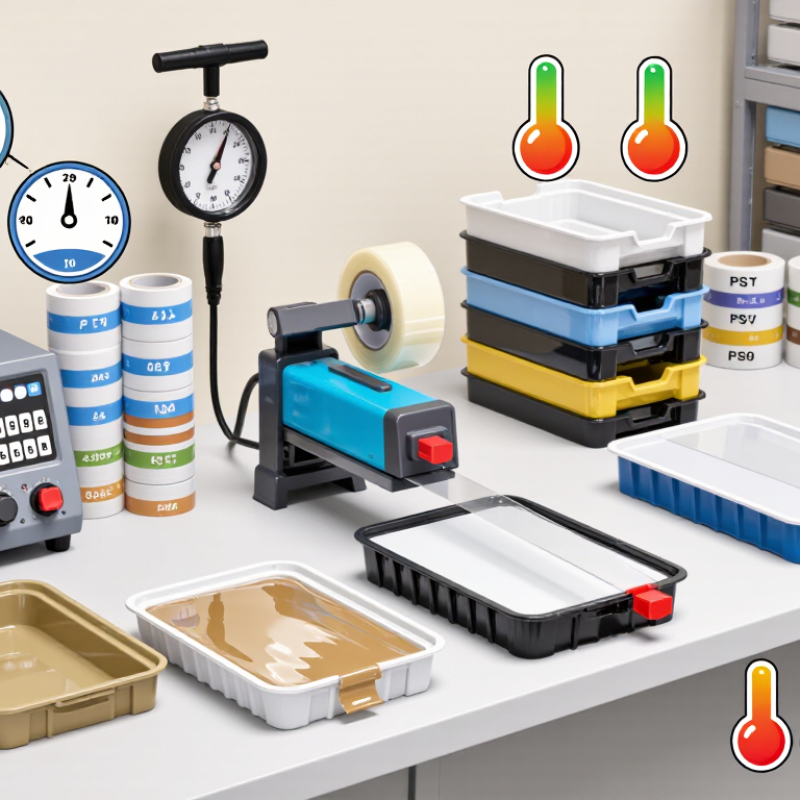
How to Choose the Right Heat Sealing Cover Tape?

Define Heat Sealing Cover Tape and Its Main Functions

Heat sealing cover tape is a polymer film bonded over carrier pockets with controlled heat and pressure. It keeps small electronic components inside during transport and automated pick-and-place feeding. The tape also limits dust exposure, reduces static risks, and allows visual inspection. The tape is not just a lid.

Its main functions depend on its construction. A stable seal must resist lifting, yet peel cleanly without scattering components. Heat-sealing temperature, dwell time, peel force, width, clarity, and antistatic performance all matter.

IPC/JEDEC J-STD-033D highlights moisture protection during handling and storage, so the tape should support the package’s moisture-control plan.

A transparent film helps operators inspect pocket alignment. That detail is easy to overlook.

Market pressure makes consistency more important.

The World Semiconductor Trade Statistics Autumn 2024 forecast placed global semiconductor sales at 611.2 billion dollars for 2024, rising to 687.4 billion dollars in 2025. SEMI’s World Fab Forecast reported approximately 33.7 million 200-millimeter-equivalent wafers of monthly capacity in 2024.

More devices mean more packaging cycles and fewer acceptable feeding errors. Select the narrowest tape that covers the pocket securely. Confirm compatibility with the carrier material and sealing equipment.

A higher seal temperature is not automatically better. It may distort the pocket or increase residue. That assumption can fail.

Small trials under real humidity and machine speed are wiser than relying only on supplier specifications.

Identify the Packaging Requirements for Your Components

How to Choose the Right Heat Sealing Cover Tape?

Identify the Packaging Requirements for Your Components

Choosing cover tape starts with the component, not the tape. Record each component’s length, width, height, weight, and surface sensitivity. A tight pocket can press against fragile leads. An oversized pocket may allow movement during transport. Small details matter.

Inspect the carrier material and pocket design before selecting a sealant layer. Different materials require different sealing temperatures, dwell times, and pressures. Check whether the component needs antistatic protection, moisture resistance, or optical clarity. Sensitive parts may also require controlled peeling to prevent shifting or discharge.

Ask how the package will move through production. Will the tape run on a high-speed machine? Will it face vibration, humidity, or long storage? Measure seal strength across the actual carrier, rather than relying only on supplier data. The peel should remain secure during handling but open smoothly during placement.

Test samples under realistic conditions. Include fresh tape, stored tape, and carriers from different production batches. Record sealing temperature, pressure, speed, peel force, and visible defects. We once treated room-temperature testing as sufficient. That confidence was misplaced; humidity changed the peel behavior.

A clear requirement sheet helps compare materials objectively. It should include component geometry, carrier type, sealing window, opening method, storage environment, and inspection criteria. Keep the process adjustable. Packaging decisions sometimes need revision after production evidence appears.

How to Choose the Right Heat Sealing Cover Tape? - Identify the Packaging Requirements for Your Components

Packaging Requirement Typical Component or Application Recommended Cover Tape Structure Typical Heat-Sealing Range Typical Peel-Strength Target Key Selection Considerations
Standard surface-mount components Resistors, capacitors, inductors and other passive components in embossed carrier tape Clear PET-based cover tape with a heat-seal coating compatible with the carrier tape Approximately 120–180 °C Approximately 0.1–0.6 N/20 mm Use a stable, low-to-medium peel force to protect small components while supporting high-speed pick-and-place feeding.
High-speed automated assembly Large-volume component lines using automatic tape-and-reel equipment High-clarity PET cover tape with consistent coating thickness and controlled peel behavior Approximately 130–170 °C Approximately 0.1–0.5 N/20 mm Prioritize uniform unwinding, low variation in peel force, anti-static performance and minimal tape curl.
Moisture-sensitive components Moisture-sensitive integrated circuits, sensors and fine-pitch electronic devices Low-moisture-transmission PET or multilayer cover tape used with a moisture-barrier packaging system Approximately 130–180 °C Approximately 0.2–0.8 N/20 mm Cover tape alone does not provide complete moisture protection; verify sealing continuity and use with a qualified dry-pack process where required.
Static-sensitive components Electrostatic-discharge-sensitive ICs, modules and semiconductor devices Static-dissipative or conductive PET-based cover tape with controlled surface resistance Approximately 120–180 °C Approximately 0.1–0.7 N/20 mm Confirm surface resistance, charge-generation behavior and compatibility with the facility’s ESD control program.
Optical or vision-inspected components LEDs, optical sensors, displays and components requiring visual inspection High-transparency, low-haze PET cover tape with a clean, non-transfer heat-seal coating Approximately 120–170 °C Approximately 0.1–0.6 N/20 mm Select low-haze material and verify that adhesive residue, coating transfer and optical distortion remain within the inspection limits.
Deep or irregular pockets Tall components, connectors and parts with uneven upper surfaces Flexible PET or multilayer cover tape with sufficient stiffness for pocket coverage and conformability Approximately 130–180 °C Approximately 0.2–0.8 N/20 mm Check tape stiffness, flex-crack resistance, pocket clearance and seal continuity around changes in pocket geometry.
Heat-sensitive components Components or carrier materials that may deform or change performance at elevated temperature Low-temperature heat-seal cover tape matched to the carrier tape’s sealing layer Approximately 90–130 °C Approximately 0.1–0.6 N/20 mm Use the lowest validated sealing temperature and confirm that dwell time, pressure and line speed still produce a continuous seal.
Long-term storage and transport Components exposed to extended warehouse storage, vibration or international shipment Tough PET-based cover tape with stable heat-seal performance and resistance to aging Approximately 130–180 °C Approximately 0.2–0.8 N/20 mm Evaluate seal aging, reel winding, temperature and humidity exposure, abrasion resistance and protection against accidental opening.
Easy manual opening Low-volume production, laboratory use, prototyping and frequent component access Low-peel-force PET cover tape with a clean-release heat-seal coating Approximately 100–150 °C Approximately 0.05–0.3 N/20 mm Balance easy opening with adequate retention; verify that the tape does not lift during indexing, vibration or normal handling.

Note: The values shown are typical starting ranges for selection. Final specifications should be confirmed through peel-force testing, seal-continuity checks, carrier-tape compatibility testing and the actual operating conditions of the packaging line.

Compare Cover Tape Materials, Widths, and Sealing Properties

Choosing heat sealing cover tape starts with the component, not the sealing machine. Polyolefin-based films offer flexibility and clean opening, while polyester films provide stronger dimensional stability. Paper-based tapes can reduce static concerns but may offer less visibility. For moisture-sensitive devices, check the tape’s barrier data carefully. “Antistatic” is not a complete specification.

Width must match the carrier pocket and sealing area. EIA-481-D identifies common carrier-tape formats, including 8, 12, 16, 24, 32, 44, and 56 mm widths. The cover tape should overlap the carrier rails evenly, without touching the pocket. A wider tape is not automatically safer. Excess width can increase waste and create uneven peeling. Measure the actual pocket, not only the catalog drawing.

Sealing properties usually decide production reliability. Compare seal temperature, dwell time, peel strength, and opening force. IPC/JEDEC J-STD-033D emphasizes controlled handling for moisture-sensitive devices, so the tape should support stable protection during storage and transport. Ask for test data at your actual sealing temperature and speed. In practice, a moderate peel force often works better than maximum adhesion. Too much force may lift small components; too little may allow contamination. I have seen trials pass at room temperature, then fail after humidity exposure. That result needs investigation, not excuses. Choose a tape with a broad sealing window, low residue, consistent release, and documented compatibility with the carrier material.

Evaluate Equipment Compatibility and Sealing Performance

Choosing a heat sealing cover tape starts with the equipment, not the tape roll. Confirm the sealer’s operating temperature, dwell time, pressure range, and compatible carrier materials. A tape may seal well in a laboratory test yet fail on a production line. Check heater control and film alignment carefully. Even a small temperature variation can leave one edge loose. Keep records from several runs, not one successful sample. Test it twice.

Evaluate sealing performance with the actual tray or container material. Run peel tests after cooling, then repeat them after storage and handling. Look for a clean peel, consistent bond, and no adhesive transfer. Measure seal strength across the center and corners. Corners tell the truth. Watch for wrinkles, channels, and trapped dust. These defects may appear minor but can compromise closure integrity. Use the intended filling level, because headspace and product residue can change the seal.

In practice, compare several machine settings before changing the tape. Lower pressure may protect delicate containers, while higher pressure can improve contact. Excessive heat, however, may deform the rim or weaken the film. Follow the technical data, but verify it on your own equipment. I once trusted a short trial and overlooked slower line speed; the result was inconsistent sealing. That mistake changed my checklist. Record temperature, pressure, dwell time, peel results, and operator observations. Not every failure belongs to the tape. Sometimes the tooling needs attention.

Select, Test, and Validate the Most Suitable Cover Tape

Choosing the right heat sealing cover tape requires more than matching width and color. Start with the component surface, carrier material, seal temperature, and peel strength. According to SEMI’s 2024 materials data, packaging materials represented about $25 billion of the global semiconductor materials market in 2023. Small sealing errors can therefore create costly handling problems. Review EIA-481 and IPC/JEDEC J-STD-033 requirements before testing. These standards support consistent pocket dimensions, sealing practices, and moisture protection.

Select two or three tape constructions for comparison. Test them on the actual carrier, using production-level equipment. Measure seal strength, peel consistency, residue, and component movement after sealing. Check performance after temperature and humidity exposure. A tape may peel smoothly at room temperature but fail after storage. That weakness is easy to miss. Validation should include operator handling, machine speed, and repeated opening tests. Perfect laboratory results are not enough.

Tips: Record temperature, pressure, dwell time, and peel angle for every trial. Use a calibrated peel tester when possible. Inspect the adhesive under magnification. Watch for stringing, wrinkles, and edge lifting. Do not accept one successful reel as proof. Repeat the test across different lots, because material variation can quietly change the result. Reconsider the specification if it protects the tape but risks damaging the component.

How to Choose the Right Heat Sealing Cover Tape?

Select, Test, and Validate the Most Suitable Cover Tape

The chart compares common cover-tape constructions using a normalized engineering screening score, where 100 represents the strongest performance for the selected criterion. Evaluation should include seal-strength consistency, controlled peel behavior, optical clarity, and electrostatic-discharge suitability. Final validation should be performed with the actual carrier material, sealing temperature, pressure, dwell time, and production equipment.